
What's the Differences Between a Hybrid, Plug-in Hybrid, and Full EV?
What’s Best For My Lifestyle: A Hybrid, PHEV, or Full EV?
Honda and other automakers offer several vehicles with electrified powertrains to improve fuel efficiency and add power. While many people associate electrification with full EVs, drivers actually have three choices: mild hybrid, plug-in hybrid, and full EVs. Deciding which is best for you involves understanding the differences and benefits of each option.
Let’s take a deep dive into the differences between a hybrid, plug-in hybrid, and full EV, and what you’ll find when you shop for one at Westshore Honda near Clearwater and Lutz, FL.
The Differences Between Electrified Vehicle Options
You don’t have to understand all of the technology and engineering under the hood, but it’s helpful to know what drivers can expect from each type of electrification. On roads in the United States, the three electric choices include:
- Mild-hybrid vehicles that combine a gas-powered engine with at least one electric motor and a small lithium-ion battery. These vehicles use the gas engine and regenerative braking to keep the battery charged.
- Plug-in hybrid vehicles combine a gas-powered engine with at least one electric motor and a larger battery. These vehicles need an external charger (usually Level 1 or Level 2) to charge the battery. Once the battery has about one percent left, the gas engine takes over, and the vehicle acts like a mild-hybrid.
- Fully electric vehicles have at least one electric motor and a large battery. These vehicles require an external charger (Level 1, Level 2, and DC fast-chargers) to fill the battery. The batteries often last at least 150 miles before they need to be charged, and they cannot function when the battery is exhausted.
Benefits of driving electrified vehicles include:
- More horsepower
- More torque
- Better fuel efficiency
- Lower or zero emissions
- Quiet rides with smooth acceleration
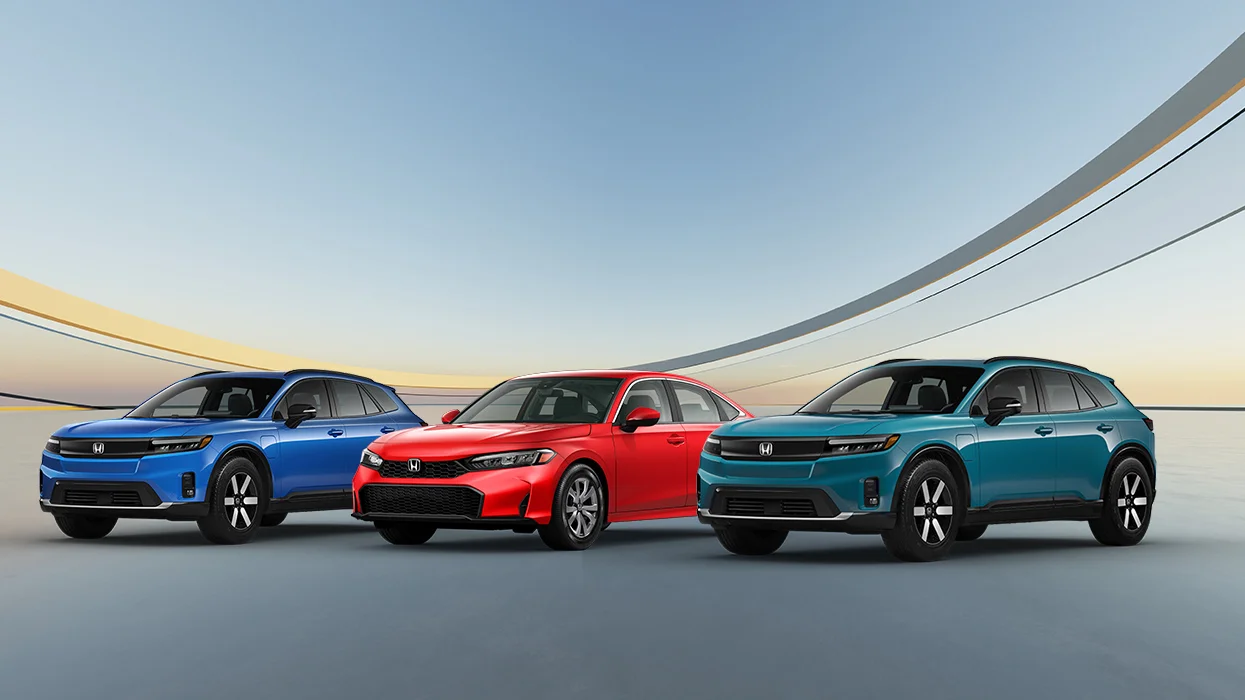
Honda currently offers several mild-hybrid vehicles and one fully-electric vehicle. The automaker did sell a plug-in hybrid, the Honda Clarity, but stopped producing it in 2021. At Westshore Honda, you’ll find these electric vehicles:
- Honda Civic Sedan Hybrid
- Honda Civic Hatchback Hybrid
- Honda CR-V Hybrid
- Honda Accord Hybrid
- Honda Prologue EV
What are the Benefits of Driving a Hybrid Vehicle?
Hybrid Honda cars and SUVs have several benefits. The Civic Hybrid, Accord Hybrid, and CR-V Hybrid all come with a 2.0-liter four-cylinder and two electric motors. This configuration gives all three mild-hybrid vehicles a satisfying amount of horsepower and impressive fuel efficiency.
Of all the electrified options, the mild-hybrid or hybrid models are the easiest to own. They rely on gasoline for power, so you never have to worry about charging or running out of a charge. Maintenance is similar to what’s needed in a vehicle with a standard internal combustion engine. Hybrid vehicles usually have an MSRP that is slightly higher than the non-hybrid models, but the difference is made up for with the lower fuel costs, which can be up to 20 MPG better!
Why Should I Choose a Plug-in Hybrid EV?
Plug-in hybrid electric vehicles (PHEV) give drivers the best of both worlds. Plug-in hybrid vehicles have a gas-powered engine and one or more electric motors powered by a lithium-ion battery. Because PHEVs have larger batteries, they often have an all-electric range of 15 to 30 miles when the battery is fully charged.
After the battery charge gets low, the vehicle acts like a mild-hybrid, using the gas-powered engine and electric motor to power the car. If you purchase a PHEV, you’ll want to charge it at home, either with your household outlet or with a more powerful 240-volt outlet (like the one that powers your dryer or stove).
PHEVs are at their peak fuel efficiency when the battery is charged, then the fuel efficiency drops when the gas-powered engine takes over. These vehicles usually have more horsepower and torque than a mild-hybrid, but not as much as a fully-electric vehicle. They are easy to own and require similar maintenance to a mild-hybrid vehicle. Because of the larger battery (usually 10 to 20 kWh), they have higher MSRPs than a hybrid or gas-powered model.
What are the Benefits of Driving a Full EV?
A fully-electric vehicle, like the Honda Prologue, has a little learning curve. The Honda Prologue comes with an 85.0-kWh battery and one or two electric motors, so it never needs gasoline, but it does need an external charging source. Most people charge their EVs with a Level 2 (using a 240-volt outlet) at home or with a DC fast-charger while on the road.
The benefits of driving an EV are many. They have no emissions and no tailpipe. EVs require minimal maintenance, and you’ll never need an oil change. The ride is quiet and smooth, and the acceleration is instant because EVs don’t have to switch gears to accelerate.
The learning curve comes with the charging experience. It is easy to charge at home, but some people experience range anxiety when taking their EVs on road trips. Fortunately, the Prologue has the CCS charging port, but it comes with an NACS adaptor for access to Tesla Super Charging stations. It doesn’t take long to learn how to use public charging stations, and since the Prologue needs about 25 minutes to fill from 20% to 80%, drivers get some time to relax while charging.
Which Electrified Powertrain is Best for Your Driving Needs?
Choosing your electrified vehicle comes down to your driving needs and priorities.
- Choose a hybrid vehicle if you want better gas mileage and don’t want to worry about charging.
- Choose the PHEV if you have a commute under 30 miles each day and want electric driving, but still want the gas backup for longer trips.
- Choose the EV if you want the lowest emissions and fuel costs, as a full battery charge is often around $5, depending on where you live and your electric rates. They are also good choices for drivers who enjoy the latest tech and aren’t afraid of learning a new way of “fueling” a car.
Ask yourself a few questions, and your answers can help you choose the best powertrain for your lifestyle:
How many miles do you drive daily?
- If your commute is under 40 miles round-trip, then an EV or PHEV is a good choice.
- If you have a longer commute with lots of highway driving, then a hybrid is best for you.
Can you charge at home?
- If yes, then choose the EV or PHEV.
- If no, then choose a hybrid.
Is your budget a concern?
- Hybrid vehicles are the lowest-priced of all electrified options.
- EVs cost more upfront, but cost less to maintain and charge.
- PHEVs often cost more upfront, but have lower fuel costs.
Find Your Electrified Honda at Westshore Honda in Tampa, FL?
Honda electrified vehicles aren’t just fuel-efficient and enjoyable to drive. They also come with the reliability and innovation that drivers expect from Honda engineers. We invite you to visit Westshore Honda in Tampa, FL to explore your electrified options. Our sales team can help you arrange a test drive, and our finance team can build a loan or lease with the latest incentives that fit your lifestyle.